
King William Former Owner Timeline
Tracing former owners works best when you separate three things: the King William County name index, the documents themselves, and the older archive trail. The online deed index starts in 1885. Image coverage is split, though. Older surviving books and microfilm may carry the chain farther back, and probate or court records often explain estate transfers that never show up as a plain sale. Treat the timeline as a route map, and confirm the exact book, reel, and image range with the custodian.
| Source | Years It Covers | Where Held | What It Shows |
|---|---|---|---|
| SRA deed index | 1885 to present | Virginia SRA/COVERS or Clerk | Parties, index references, and deed trail |
| Online deed images | 1874-1886 and 1928 to present | SRA subscriber access | Image ranges; index hits may lack an online image |
| Early deed books | 1702-1705; 1793-1802; later series from 1885 | Library of Virginia catalog and Clerk | Historic conveyances and book references |
| Historic index, court, tax, and probate books | Index 1885-1981; tax books 1813-1816; court books from 1702 | Library of Virginia reels and Clerk | Transfer context beyond a modern deed chain |
A recent transfer starts with SRA and the newest deed. When an older transaction lacks an image, pull the deed book itself. Ask the Clerk about surviving local volumes. If the chain crosses a death or an estate, wills and fiduciary records come next. The Library of Virginia's King William microfilm catalog lists deeds, indexes, tax books, court books, guardians' accounts, and wills.
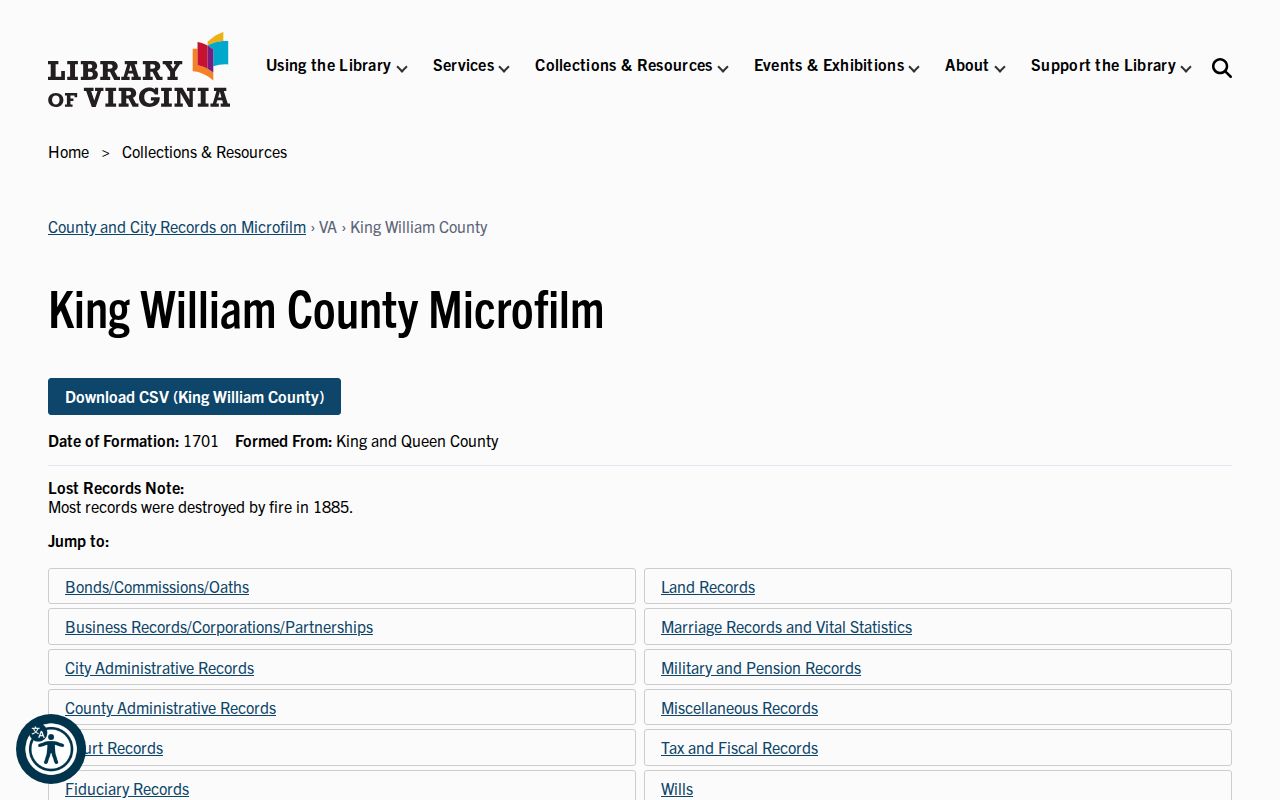
The catalog identifies reels and record series worth requesting. Not every volume exists as a web image.
Walking Back Through King William Deeds
Follow grantor and grantee references backward rather than hammering the same address search. That is the trick. A grantor conveys an interest. A grantee receives it. The newest deed names the current grantee. It often points to the prior grantor or an earlier recording reference. Match the parcel's legal description and Tax Map Number. That way you know the earlier instrument covers the same tract. Try name variants and initials. One family or entity can appear under several forms in the King William County deed records.
- Find the latest deed with the current grantee name and note the recording reference.
- Read the grantor, date, legal description, and prior deed citation.
- Search that grantor as a grantee in an earlier date range, then compare the parcel description.
- Continue until the index or book trail ends, and switch to historic records where needed.
- Grantor / grantee
- The party conveying / receiving the recorded interest.
- Chain of title
- The linked sequence of deeds and related records for one parcel.
- Legal description
- The written land description used when older records lack a current street address.
King William Index and Image Gaps
King William County's SRA agreement lists a deed index from 1885 to the present. Deed images cover 1874 to 1886 and 1928 forward. Selected images cover other series for 1816 to 1822, 1870 to 1871, and 1879 to 1881. A broad image gap separates the historic and modern runs. An index entry can still identify a transfer even where no image can be viewed. Record the party names, the date, and the reference. Then ask the Clerk or the archive how to inspect the source volume.
Images require a subscriber agreement and an advance fee. The Clerk's application must be notarized and submitted online or in person. Free index-only access may be enabled locally. A web image is convenient. It is not the only route to the former-owner chain.
Coverage differs between the two. The index and image route begins at Virginia SRA/COVERS.
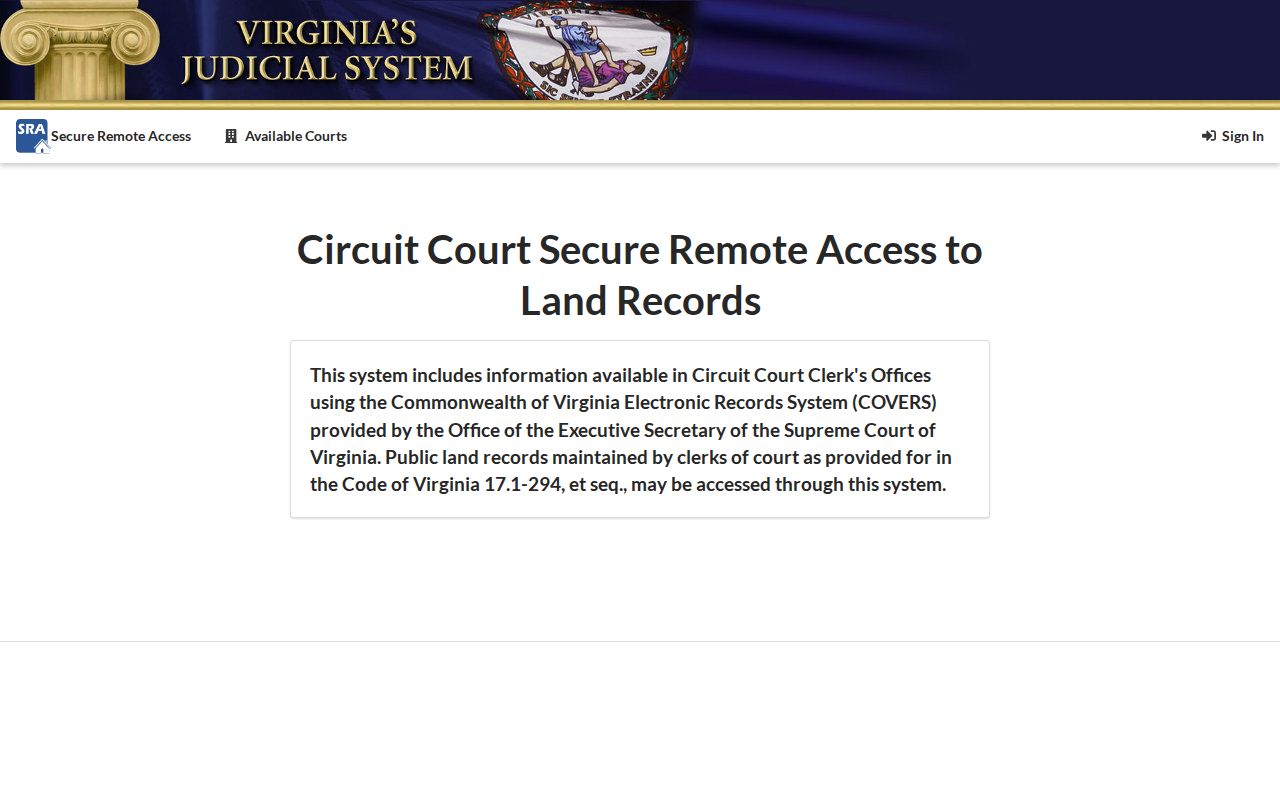
Check index and image coverage before giving up.
King William's Surviving Deed Books
The Library of Virginia catalog lists Deed Book 1 from 1702 to 1705 and Deed Book 2 from 1793 to 1802, each with indexes. Deed books 1 through 17 cover 1885 to 1901. County Court Records Books 1 through 6 run from 1702 to 1816, and old tax books cover 1813 to 1816. Old tax books cover 1813 to 1816. A chain reaching the colonial period may rest on a deed book, a court order, a tax entry, or an estate file rather than a modern deed image. Deeds are only part of it.
The catalog also lists a General Index to Deeds, Release Deeds, Miscellaneous Liens, Wills, and related records from 1885 to 1981. Its visible description covers grantors A to B only. Ask about the full reel scope. The Clerk can confirm local holdings. The index cut-off does not mean every earlier King William transfer is missing. Early books remain cataloged, though coverage and images must be checked book by book.
Courthouse Fires and Former Owners
Fires in 1864 and 1885 destroyed some King William courthouse books and spared others. A blank image is not proof of absent ownership. Blanks often reflect the records' own history. Keep a research log with three columns: the SRA index hit, the surviving image or book, and any substitute evidence from a plat, a probate file, chancery material, or a court book.
The Clerk's SRA agreement describes the courthouse losses. The Library of Virginia supplies the catalog. The loan program covers selected reels. The county Historical Society appears as a public-information link, though its holdings vary. A title professional can step in. Where the surviving record set runs thin, that professional can assess the deed chain.
Estate Transfers in King William
Not every former owner sold land outright. Some parcels moved through a will, a guardian, an administrator, a commissioner, or a court order. The Clerk's Wills & Deed Division holds the wills and fiduciary records behind those transfers, and the SRA agreement lists a will-book index plus books from 1885 forward. The Library catalog adds fiduciary accounts and guardians' records. Search both names. Then chase the deed or court order that actually carried the land to an heir or buyer.
Death and marriage records help frame the family story. They cannot prove title. Virginia limits vital-record access with confidentiality periods, and certified copies carry eligibility rules. For a real property-history answer, pair the land record with probate and court material instead of treating a name in a family record as ownership.
Note: Ask the Clerk's Wills & Deed Division at 804-769-4901 about the index and volumes on hand.
Plats and Older King William Addresses
A chain check has to compare the parcel's legal description, not just the street address. King William's Enhanced E-911 project started in September 1997. Older deeds may instead name a road, route, farm, river, creek, wharf, or landmark. A recorded plat can tie those terms to subdivision lots. It can also resolve easements, road dedications, or boundary shifts. The Clerk maintains the plat books. The SRA agreement folds all of them into its subscriber collection.
When two deeds look alike, set them side by side. Compare acreage, adjoining land, watercourses, roads, and plat references. The parcel map helps with orientation. A recorded plat and the written description carry more weight in the chain. If the portal index lacks detail, ask the Clerk for the specific book or instrument.
How Far King William Ownership Goes
King William's surviving land record history reaches back to 1702. That history sits in the Library of Virginia catalog. The modern SRA deed index starts in 1885, and historic deed images cover only certain years. Fires in 1864 and 1885 destroyed some volumes. Others were saved. A former-owner chain may therefore draw on the Clerk and the Library of Virginia. Probate and court materials help. Recorded plats can bridge the gaps too. Treat no single online result as the end of a search. Let the source coverage decide that.
When an index trail stops, keep the last known deed citation. Ask for the book or reel by its exact series and date. King William's catalog includes a General Index to Deeds, Release Deeds, Miscellaneous Liens, and Wills. It also holds guardians' accounts and fiduciary records. Those materials can show who acted for a prior owner. They can also show where a transfer continued after death. A tax-book entry may reveal how land was listed in a given year. It is supporting context, not a conveyance. Before calling two references the same tract, compare the name, acreage, adjoining owners, and land description.
Lawful use. Research past ownership for property history, title review, or estate work. Do not use an old owner's name or address to follow, harass, or harm a living person.